
How Chesapeake Probate Works
Virginia does not run a stand-alone probate court. Probate is handled in the Circuit Court of the city or county where the person lived at death. In Chesapeake, that means the Clerk of the Circuit Court or a deputy clerk. Usually a judge is not involved at all. An interested person may appeal to the judge within six months of the clerk's order admitting a will to probate.
Probate is needed when the person owned assets in their own name alone, without a joint owner or survivorship. Many assets pass outside probate, such as property held jointly with right of survivorship or accounts with a named beneficiary. Those do not need the Clerk's process at all. The Chesapeake probate page explains the process, the appointment rule, and the testate and intestate basics.
The city's probate page lays out the appointment steps and a helpful FAQ for wills and estates, on the Chesapeake Probate page.
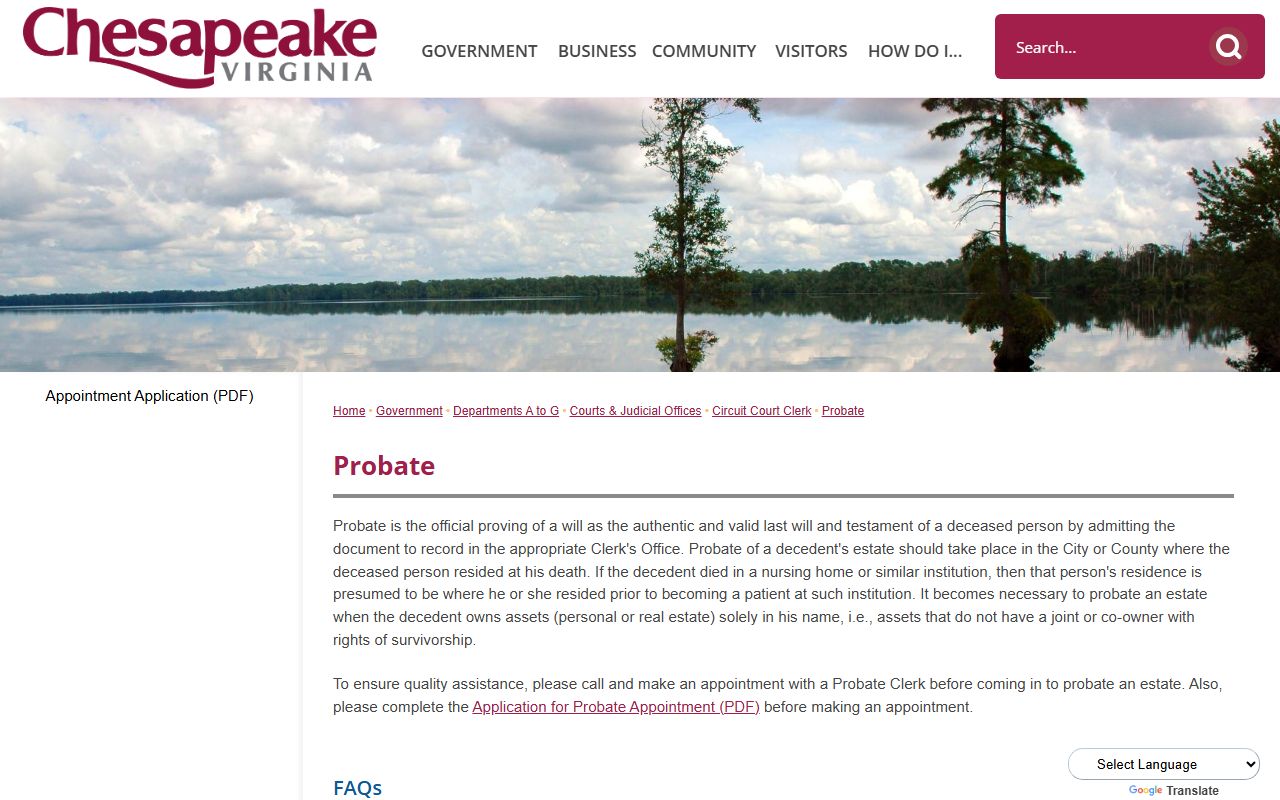
That page is the best first read before you call to set an appointment.
The Chesapeake Probate Appointment Process
Chesapeake asks you to prepare before you arrive. You must call and make an appointment with a Probate Clerk, and you should complete the Application for Probate Appointment before that appointment. This is stronger guidance than a simple "go to probate court," and it saves time. Probate contact runs through the Circuit Court Clerk.
Circuit Court Clerk, Probate Division
307 Albemarle Drive, Suite 300A
Chesapeake, VA 23322
757-382-3000
CCCProbate@CityofChesapeake.net
- Complete the Application for Probate Appointment.
- Call the Probate Clerk to schedule an appointment.
- Gather the will, death certificate, asset values, and heir details.
- Attend the appointment to qualify and post any required bond.
- Begin the executor or administrator duties on the timeline below.
What to Bring With a Will
When the person left a will, the Clerk needs the original document and supporting papers. The Probate Clerk examines the will for a self-proving clause. If it is not self-proving, witnesses or depositions may be needed. Bring these items to the appointment.
- The original will.
- A certified death certificate or a copy of the obituary.
- Approximate value of solely owned personal property and Virginia real estate.
- Names, ages, and addresses of the heirs-at-law.
- A renunciation letter if a named executor will not serve, or a death certificate if that executor has died.
- Cash or a check for the fees.
A nonresident executor must bring a Virginia resident to co-qualify or be named as a registered agent. All fiduciaries must be bonded, and the Clerk sets the bond at qualification. Whether the bond needs a surety depends on the will and the statutes, so the Clerk decides that at the appointment.
What to Bring Without a Will
When there is no valid will, the estate is intestate, and Virginia law decides who inherits. The process still runs through the Clerk, and someone qualifies as administrator. Bring the items that let the Clerk identify heirs and value the estate.
- A certified death certificate.
- Names, ages, and addresses of the heirs-at-law.
- Approximate values of solely owned assets and Virginia real estate.
- Cash or a check for the fees.
As with a will, a nonresident administrator needs a Virginia resident to co-qualify or serve as registered agent, and a bond is required. The Clerk sets the bond amount based on the estate and the statutes.
Common Chesapeake Probate Terms
Probate uses words that confuse many families. A few quick definitions make the rest of the process easier to follow.
- Testate
- The person left a valid will.
- Intestate
- The person died without a valid will, so state law sets the heirs.
- Executor
- The person named in a will to settle the estate.
- Administrator
- The person the court qualifies to settle an estate with no will.
- Guardianship
- Court authority over the care of a person who cannot manage their own affairs.
- Conservatorship
- Court authority over the finances of a person who cannot manage them.
Executor and Administrator Duties
Once qualified, the fiduciary takes on real deadlines. The job is to gather the estate, pay valid debts, and distribute what is left under the will or under Virginia intestacy law. The deadlines below are the ones that catch people off guard.
- Take possession and control of the estate property.
- Determine the assets and the liabilities.
- Pay the valid debts of the estate.
- Give written notice of qualification to heirs and beneficiaries within 30 days.
- File a complete inventory within four months with the Commissioner of Accounts.
- File annual accountings until the final accounting.
For a simple estate, the first and final accounting often comes at the end of the first year. Missing a deadline can lead to a summons from the Commissioner of Accounts, so a calendar matters. A fiduciary who is unsure of a duty can ask the Commissioner's office or hire counsel rather than guess.
Intestate Succession in Virginia
When there is no will, Virginia sets a clear ladder of heirs. The Chesapeake FAQ gives the basic order, which decides who takes the estate after expenses and debts.
- All to the surviving spouse, unless there are children or descendants of someone other than that spouse.
- If there are such children, one-third to the spouse and two-thirds split among all children.
- If there is no spouse, all to the children and their descendants.
- If none, to the father and mother, or the survivor.
- If none, to brothers and sisters or their descendants, then further contingencies in the statutes.
The full rules on wills, intestacy, and fiduciaries sit in Va. Code Title 64.2.
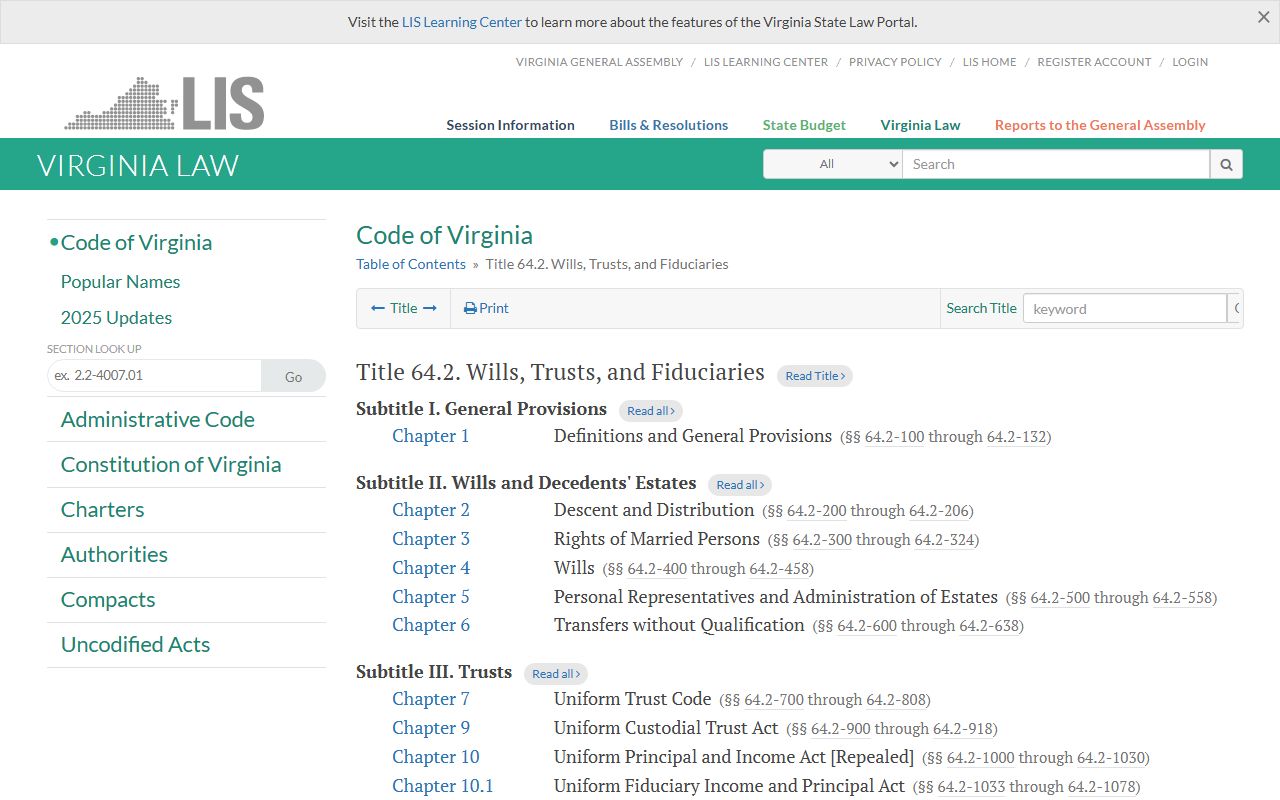
That title also governs guardian and conservator appointments, inventories, and accountings.
Chesapeake Probate Fees
Copy fees are simple and posted, while the full probate fee schedule is set by statute and varies with the estate. The Clerk charges $0.50 per page for a plain copy and $2.00 for certification with a raised seal. Probate taxes and fiduciary fees depend on the value of the estate, so confirm the exact amount with the Probate Clerk before your appointment.
| Item | Amount |
|---|---|
| Plain copy per page | $0.50 |
| Certification / raised seal | $2.00 |
| Probate tax and fiduciary fees | Set by statute; varies by estate value |
Note: The exact Chesapeake probate fee schedule is set by Virginia law and estate value, so ask the Probate Clerk to confirm before you pay.
Viewing and Searching Probate Files
Probate files become public court records once they are filed, with some limits. A typical estate file can include the original will, the order admitting it to probate, the qualification of the executor or administrator, the bond, the list of heirs, the inventory, and the accountings. Together these papers show how an estate was settled.
You can view many of these records at the Clerk's office on the third floor, or through the paid Secure Remote Access for indexed documents. The Commissioner of Accounts reviews inventories and accountings, so some estate filings route through that office as well. Bring the decedent's name and the approximate year to speed a search. Adoption files and other sealed matters are not part of the open probate record, so do not expect those to appear.
Will Records Back to 1755
Chesapeake holds unusually deep will records for a modern city. The Clerk's Secure Remote Access lists will indexing and imaging from 1755 to the present, by paid subscription. That depth reflects the city's roots in older Norfolk County and South Norfolk governments before the 1963 consolidation.
For genealogy, title, and estate research, those old wills can be valuable. The records are available through the paid remote system or by an in-office visit. For the subscription tiers and coverage, see the Clerk of the Circuit Court page.