
How to Check for Chesapeake Warrants
There is no single website that lists every active Chesapeake warrant. The official sources do not publish one. Instead, the trusted path runs through the Warrant Unit and the courts. For outstanding warrants and summonses, the Magistrate page directs people to call the Warrant Unit at 757-382-6388 or 757-382-6389. That is the authoritative local contact.
You can also use the court case systems to find a related charge. If you know a case number, a name, or a hearing date, the Virginia criminal and traffic case search may show a connected case. That is not the same as a warrant search, but it can point you to the matter behind a warrant.
Be careful with what you share by phone, and consider talking to a lawyer before you act. Then follow these steps.
- Call the Chesapeake Warrant Unit at 757-382-6388 or 757-382-6389.
- Have the full legal name and date of birth ready.
- Search the Virginia court case systems for any related charge.
- Speak with an attorney before turning yourself in or paying anything.
- Get written proof once a warrant is recalled, quashed, or resolved.
No Public Online Warrant List for Chesapeake
It helps to set expectations early. Official Chesapeake and Virginia sources do not offer a public, searchable active-warrant database. Any third-party site that claims to list all local warrants is not an official source and should not be trusted as accurate. Warrant data is sensitive, and broad public posting could interfere with arrests and investigations.
Some warrant details become visible only after a warrant is served or after a case appears in court. Until then, the official phone contact is the reliable answer. Treat the Warrant Unit and the Magistrate Office as the real starting point, not a web search.
This also protects people from scams. Callers sometimes claim a person has a warrant and demand payment by gift card or wire. No Chesapeake court or magistrate collects warrant money that way. Court fines are paid only through the official Virginia court payment portal, and a real warrant is never cleared by a phone payment to a stranger.
The Chesapeake Magistrate's Role
Magistrates are the judicial officers who issue many warrants. The Chesapeake Magistrate Office works under the Office of the Executive Secretary of the Supreme Court of Virginia. Magistrates are neutral and do not take sides. They are not investigators, and they do not prosecute. They give an independent review of complaints brought by police officers, sheriff's deputies, and citizens.
The Magistrate page explains this role and lists the Warrant Unit contact, on the city's Magistrate page.
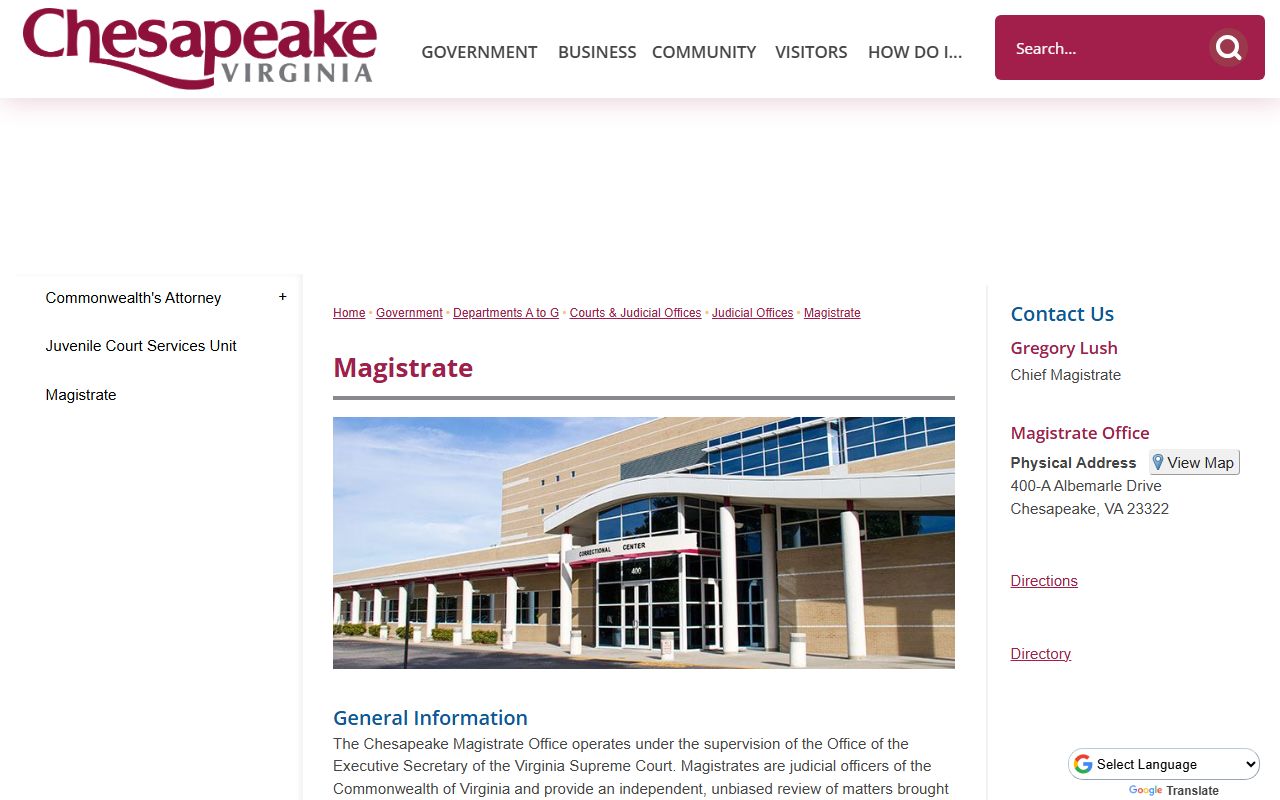
A magistrate can issue a warrant, a summons, an emergency protective order, or a bail decision. A magistrate cannot give legal advice or clear a warrant over the phone without the proper court process.
Citizens can also bring complaints to a magistrate, not just police. The magistrate then weighs whether there is probable cause for a charge. This independent check is meant to protect both the public and the accused, since the officer who seeks a warrant is not the one who grants it.
Types of Warrants in Chesapeake
Not every warrant means the same thing. Some authorize an arrest. Some authorize a search. Some are civil and have nothing to do with a criminal arrest. Knowing the type helps you respond the right way.
- Arrest warrant - lets police take a person into custody based on probable cause.
- Search warrant - lets law enforcement search a place or seize listed items.
- Bench warrant or capias - issued by a court after a missed date, a probation violation, or contempt.
- Summons - requires a person to appear, without an immediate arrest.
- Civil warrant - in district court, a warrant in debt or unlawful detainer is civil process, not a criminal arrest.
- Fugitive warrant - used when another jurisdiction wants a person.
Civil Warrant vs Criminal Warrant
The word "warrant" trips people up in Virginia. In the district courts, a "warrant in debt" or an "unlawful detainer" is a civil case, not an order to arrest anyone. A criminal arrest warrant is a very different thing. The comparison below keeps the two straight, because a civil warrant in debt does not put a person in jail.
| Point | Civil Warrant | Criminal Warrant |
|---|---|---|
| Purpose | Start a money or eviction case | Authorize an arrest or search |
| Examples | Warrant in debt, unlawful detainer | Arrest warrant, bench warrant, capias |
| Court | General District Court civil docket | Criminal docket and magistrate |
| Risk of arrest | No | Yes |
If you received a civil warrant in debt, the next step is a civil court date, not a surrender. The Chesapeake court records page covers those civil case searches.
What a Chesapeake Warrant Record Shows
A warrant record is a court or magistrate document. Its details vary by type, but a few fields appear on most. The list below shows the kind of data a warrant carries once it is in the system. Sealed warrants are not public, so these fields may not be visible until the warrant is served.
- Warrant type, such as arrest, bench, or search.
- The issuing authority, a magistrate or a judge.
- The subject's name and identifying details.
- The charge or the reason for the warrant.
- The date issued and the current status.
- Any related court case number.
Chesapeake Warrant Lookup Options
Because there is no public database, the lookup is really a set of contacts and tools. The table below lays out each option and what it can do. The phone inquiry to the Warrant Unit is the most direct, while the court case search helps with the case behind a warrant.
| Option | Type | What It Does |
|---|---|---|
| Public online warrant search | n/a | Not offered by official Chesapeake sources. |
| Warrant Unit phone inquiry | Phone | Call 757-382-6388 or 757-382-6389 for outstanding warrants and summonses. |
| Court case search | Court portal | Search a criminal or traffic case by name, case number, or hearing date. |
| Magistrate or law enforcement | In person / phone | For complaints, judicial review, and surrender questions. |
How to Resolve an Outstanding Chesapeake Warrant
An outstanding warrant does not go away on its own. Ignoring it can lead to an arrest at a traffic stop or a routine contact. The smart move is to handle it on your terms, with help. Do not rely on a third-party list, and do not assume a payment clears every warrant.
- Call the Warrant Unit or contact a defense attorney first.
- Search any related court case if you know the case number.
- If represented, let your attorney contact the court or prosecutor about bond and appearance.
- If you turn yourself in, confirm the location, hours, and the rules on phones and property.
- Expect a magistrate and bond process after arrest or surrender.
- Pay eligible fines or costs only through the official court payment portal.
- Get written proof of any recall, quash, dismissal, or payment from the court.
Bond and the Magistrate After Arrest
After an arrest or a surrender, the magistrate often handles the first bail decision. The magistrate reviews the charge and sets conditions for release, which may be a recognizance bond, a secured bond, or a hold for a judge. Bond terms can be revisited by the court at the next hearing.
This is one reason the Magistrate Office matters in the warrant process. It sits between the arrest and the courtroom, making the early calls on custody. A person held on a bench warrant for a missed court date may be released once the new date is set, while a serious charge may be held for a judge. For how a case then moves through court, see the Chesapeake arrest records page.
Sealed and Juvenile Warrant Limits
Some warrants are not public at all. Sealed warrants and sealed indictments stay hidden until they are unsealed or executed, because early disclosure could tip off a suspect or harm an investigation. Juvenile warrants are confidential under state law, which limits public access the same way other juvenile court records are limited. Search warrants are especially sensitive before they are carried out.
Note: Real-time warrant status can change at any moment, so confirm with the Warrant Unit or the court rather than relying on any online list.